The Chinese language is a family of closely related dialects, including Mandarin, Cantonese, Wu, and others. Mandarin is the official language of China and is spoken by the majority of the population.
There are several types or varieties of Chinese Language, which can be broadly divided into two categories: Mandarin and non-Mandarin dialects.
Mandarin is the official language of China and is spoken by the majority of the population. Standard Mandarin, also known as Putonghua, is based on the Beijing dialect and is the language used in education, media, and official communication throughout the country. Mandarin is also spoken in Taiwan and Singapore.
Non-Mandarin dialects include Cantonese, Wu, Min, Hakka, and others. Cantonese is spoken in southern China, including Hong Kong and Macau, and is also spoken by some overseas Chinese communities. Wu dialects are spoken in the Yangtze River Delta region, which includes Shanghai. Min dialects are spoken in Fujian, Taiwan, and parts of Southeast Asia. Hakka is spoken in Guangdong, Fujian, Jiangxi, and Taiwan.
Each dialect has its own unique features in terms of pronunciation, vocabulary, and grammar. However, all varieties of Chinese share the same writing system, which is based on Chinese characters.
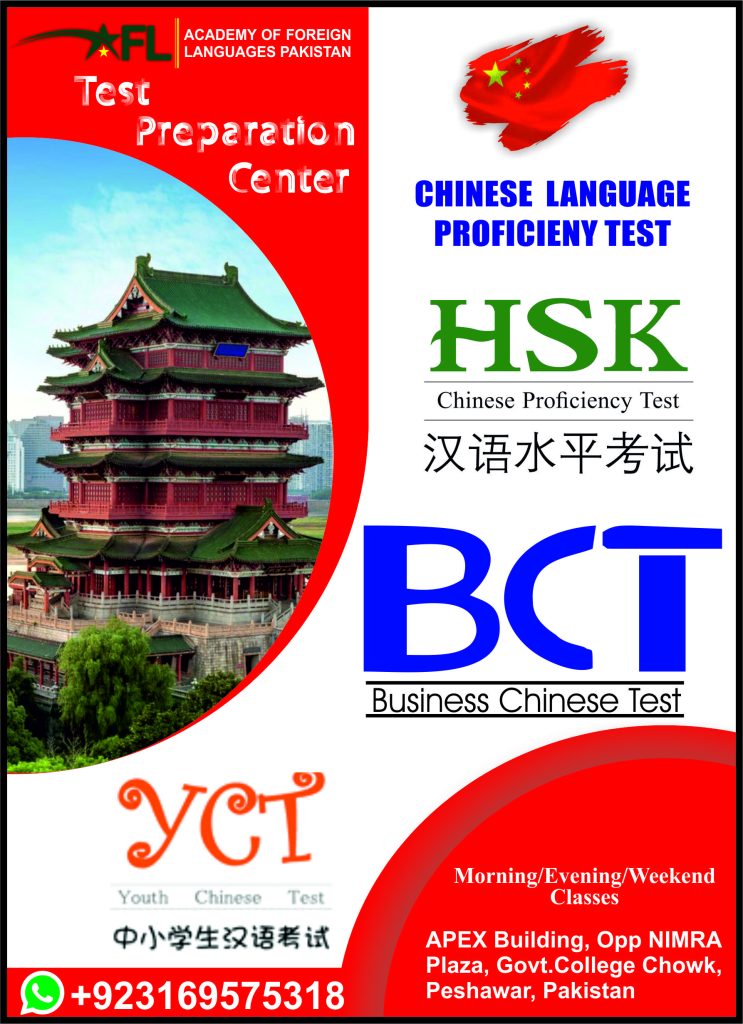
Hanyu Shuiping Kaoshi – HSK
The Hanyu Shuiping Kaoshi – Chinese Proficiency Test is built to establish language skills for non-native Chinese speakers. This course is most reliable indicator for Chinese Language skill, as it is created and managed by specialists of the Chinese Ministry for Education.
According to Hanyu Shuiping Kaoshi the Chinese Language is subdivided in 6 Official Levels i.e HSK 1 to 6
Business Chinese Test – BCT
The Business Chinese Test, establishes the student’s ability to communicate in a business environment and provides a basis for employers to make decision regarding employee recruitment, selection, placement and promotion. It is held by the Chinese Ministry of Education (Hanban) and is composed of two main parts: Reading & Writing and Listening & Speaking.
Youth Chinese Test – YCT
The new YCT test was launched by the Chinese Ministry of Education in an effort to encourage foreign young students to learn Chinese and improve their Chinese language proficiency. It consists of two parts: a writing test and a speaking test. The writing test is divided into four difficulty levels while the speaking test is divided into the beginner and intermediate level HSK1 & HSK2
Listen the basic infromation
Types of Chinese Professional Exams
There are several professional exams for Chinese language and culture, which are designed to assess specific skills and knowledge related to various fields. Some of the most well-known professional exams for Chinese include:
- HSK (Hànyǔ Shuǐpíng Kǎoshì): As mentioned earlier, the HSK is a standardized test for assessing Chinese language proficiency for non-native speakers. It is widely recognized by universities, employers, and other organizations in China and abroad.
- BCT (Business Chinese Test): The BCT is designed to assess the Chinese language proficiency of non-native speakers in business settings. It assesses listening, reading, and writing skills related to business vocabulary and scenarios.
- C-TEST (Chinese Test): The C-TEST is a language proficiency test developed by the Chinese Testing International (CTI) and is used to assess Chinese proficiency in academic and professional contexts.
- HSKK (Hànyǔ Shuǐpíng Kǒuyǔ Kǎoshì): The HSKK is a test of Chinese speaking proficiency, which assesses the ability to use Chinese in real-life situations such as giving a speech or participating in a conversation.
- TSC (Test of Spoken Chinese): The TSC is another test of Chinese speaking proficiency, which assesses the ability to use Chinese in academic and professional settings.
- YCT (Youth Chinese Test): The YCT is a test of Chinese language proficiency designed for non-native speakers aged 7 to 15 years old. It assesses listening, reading, and writing skills.